> For the complete documentation index, see [llms.txt](https://docs.tabiya.org/llms.txt). Markdown versions of documentation pages are available by appending `.md` to page URLs; this page is available as [Markdown](https://docs.tabiya.org/tabiya-documentation/deutsch/unser-technologie-stack/livelihoods-classifier.md).
# Livelihoods Classifier
Der Tabiya Livelihoods Classifier bietet eine benutzerfreundliche Implementierung des Entity-Linking-Paradigmas zur Unterstützung von Heuristiken für Stellenbeschreibungen.
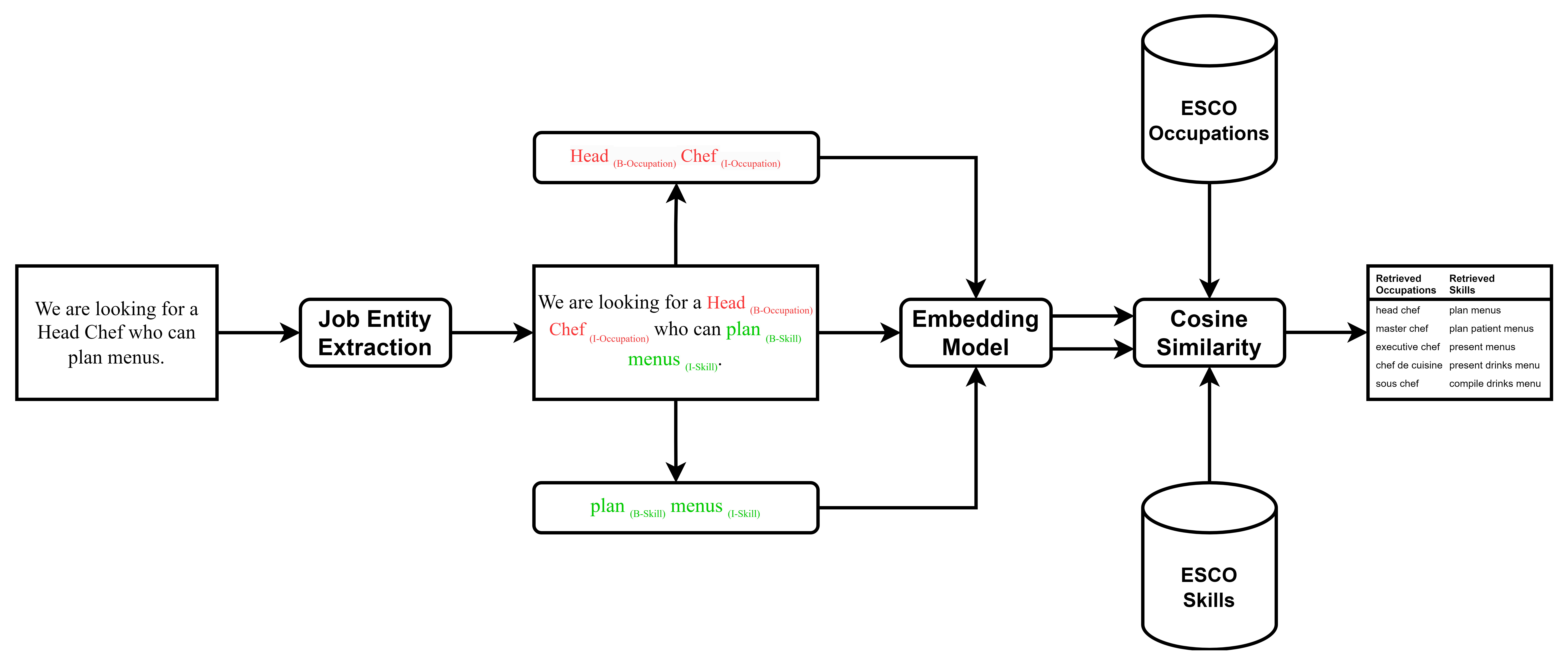
Mithilfe modernster Transformer-Neuronaler Netze kann dieses Tool 5 Entitätstypen extrahieren: Beruf, Fähigkeit, Qualifikation, Erfahrung und Bereich. Für die Berufe und Fähigkeiten werden ESCO-bezogene Einträge abgerufen. Das Verfahren besteht aus zwei getrennten Schritten: Entitätsextraktion und Ähnlichkeitsvektor-Suche.
### Architektur des Modells
Job Entity Linking Pipeline
### Zielgruppe
Das Tool richtet sich an Spezialisten für Workforce Analytics, Rekrutierungstechnologien und Human Capital Management sowie an Forschende mit Schwerpunkt auf Arbeitsmärkten und Stellendaten. Es eignet sich für Organisationen und Fachleute, die Stellenbeschreibungen oder Lebensläufe in großem Umfang analysieren, kategorisieren und optimieren. Ideale Nutzer sind Personen aus der HR-Technologie, der Karriereberatung und datengetriebenen Talentlösungen, insbesondere jene, die die Präzision bei der Identifizierung von Rollen, Fähigkeiten und Qualifikationen verbessern möchten, um fundiertere Entscheidungen bei der Einstellung oder der Personalplanung zu treffen. Auch technische Anwender, die standardisierte Frameworks in ihre Analysen integrieren möchten, werden dieses Tool als besonders relevant empfinden.
### Verwandte Forschung
Das Design und die Evaluation unseres Livelihoods Classifier werden in Saroglou, S., Diamantaras, K., Preta, F., Delianidi, M., Benisis, A. & Meyer, C.J. (2025). Enhancing Job Matching: Occupation, Skill and Qualification Linking with the ESCO and EQF taxonomies vorgestellt. *arXiv-Preprint arXiv:2512.03195*. .
{% hint style="info" %}
Den gesamten zugehörigen Code finden Sie auf [Tabiyas GitHub-Seite](https://github.com/tabiya-tech/tabiya-livelihoods-classifier/tree/main).
{% endhint %}
---
# Agent Instructions
This documentation is published with GitBook. GitBook is the documentation platform designed so that both humans and AI agents can read, navigate, and reason over technical content effectively. Learn more at gitbook.com.
## Querying This Documentation
If you need additional information that is not directly available in this page, you can query the documentation by asking a question.
Perform an HTTP GET request on the following URL with the `ask` and `goal` query parameters:
```
GET https://docs.tabiya.org/tabiya-documentation/deutsch/unser-technologie-stack/livelihoods-classifier.md?ask=&goal=
```
`ask` is the immediate question: it should be specific, self-contained, and written in natural language.
`goal` is what the user is ultimately trying to achieve, the reason they need the answer. Sharing it helps GitBook give you a better, more relevant answer. A goal is most helpful when it describes the outcome the user wants rather than restating the question. For example, with `ask=how do I create an API token`, a goal like `automate deployments from our CI pipeline` lets GitBook tailor the answer to that use case.
The response will contain a direct answer to the question and relevant excerpts and sources from the documentation.
Use this mechanism when the answer is not explicitly present in the current page, you need clarification or additional context, or you want to retrieve related documentation sections.